


Replacement of the timing chain and peripheral components in Varna
€ 400
The service price may vary depending on the year of manufacture and mileage of your car.
We choose only the best


In engines with a timing chain, the chain synchronizes the crankshaft and the camshaft. It has a longer life than the belt, but a stretched chain can skip teeth and jeopardize the engine's integrity.
Symptoms of a stretched chain
- a rattling or clattering noise on cold start;
- phase sensor errors and unstable running;
- a metallic noise from the front of the engine.
What the peripheral components include
The chain is replaced together with the tensioner, guide rails and sprockets, and, if necessary, the variable valve timing phasers. Replacing the complete kit ensures accurate synchronization.
Difference between timing chain and timing belt
The difference between a timing chain and a timing belt is fundamental to the design and maintenance of any internal combustion engine. Although both components perform the same role – to synchronize the rotation of the crankshaft and the camshaft – they differ in material, durability, operating method and maintenance.
Basic comparison:
- Material and construction:
- Timing chain: Made of high-strength hardened steel. It typically runs inside the engine itself and is continuously lubricated by the engine oil.
- Timing belt: Made of synthetic rubber reinforced with rubber cords and fiberglass fibers.
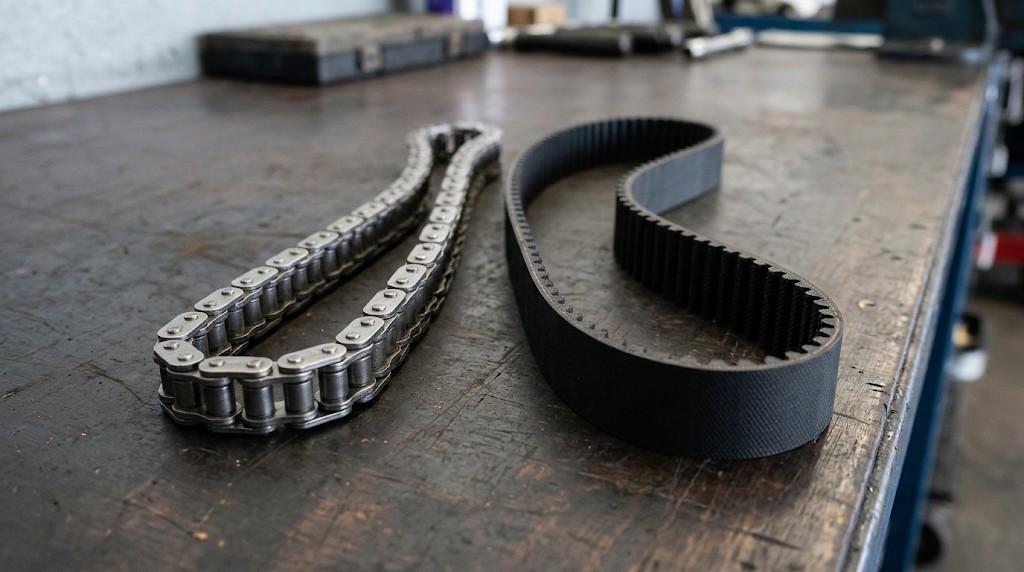 It operates dry outside the oil system (except for so-called wet belt systems).
- Lifespan and replacement interval:
- Chain: Designed for a significantly longer service life – typically between 200,000 and 300,000 km, and with regular changes of quality oil it can last the entire life of the vehicle.
- Belt: Has a strictly defined service life by the manufacturer – usually replaced every 60,000 to 120,000 km or every 5–6 years (due to rubber aging), regardless of mileage.
- Symptoms of wear:
- Chain: Wear or stretching of the chain gives preliminary warning sounds – a characteristic metallic or rattling noise on cold start, as well as illumination of the Check Engine light due to a mismatch in valve timing.
- Belt: The belt usually breaks suddenly without prior audible warning, leading to an immediate loss of synchronization and severe engine damage (collision between pistons and valves).
- Maintenance and costs:
- Replacing the belt: The procedure is relatively quicker and cheaper in parts and labor.
- Replacing the chain: Needed less frequently, but the procedure is significantly more complex, takes more time and is more expensive, as it requires disassembly of the front of the engine and replacement of the entire kit (tensioners, rails, sprockets and oil seals).
Why can't they be mixed or interchanged?
The drive type (chain or belt) is factory-determined in the engine's design. The block, cylinder head, oil system and side covers are specifically engineered for the respective mechanism. For this reason it is not possible to convert from a belt to a chain or vice versa.
Frequently Asked Questions
What is the difference between a timing chain and a timing belt?
At how many kilometers should the timing chain be changed?
What are the signs of a stretched chain?
What risks does a delayed change entail?

Open in Google Maps
Varna, Hr. Smirnenski Blvd., 29