


19 November 2026
ReadShock absorbers – signs of wear and at what mileage they should be replaced
16 November 2026
Contents
- Most common symptoms of worn shock absorbers
- When to replace shock absorbers?
- How to check shock absorbers?
- Why are shock absorbers replaced in pairs?
Shock absorbers rarely fail suddenly. Their effectiveness usually decreases gradually, and the driver unconsciously gets used to the softer behavior of the car, increased body roll and longer settling after a bump. Therefore the problem is often noticed only when a leak, knocking, or a noticeably unstable car appears.
Serviceable shock absorbers are not only for comfort. They control the movement of the springs and help the tires keep contact with the road. When worn, handling, grip and braking behavior can deteriorate.
Most common symptoms of worn shock absorbers
A single sign is not always sufficient for a definitive diagnosis. However, a combination of several symptoms is a serious reason to have the car inspected.
- Prolonged bouncing after a bump. After passing a pothole or speed bump the body should settle quickly. If the car continues to sway, the shock absorbers are likely not adequately limiting the motion of the springs.
- Severe nosedive when braking. Pronounced forward pitching indicates that weight transfer is not well controlled. This can make the car more unstable during sudden braking.
- Excessive body roll in corners. The car feels "floaty", responds with delay and requires more steering corrections. This symptom is often noticed also during a quick lane change.
- Instability at high speed or in crosswind. Worn suspension can make the car more sensitive to gusts, load and road irregularities.
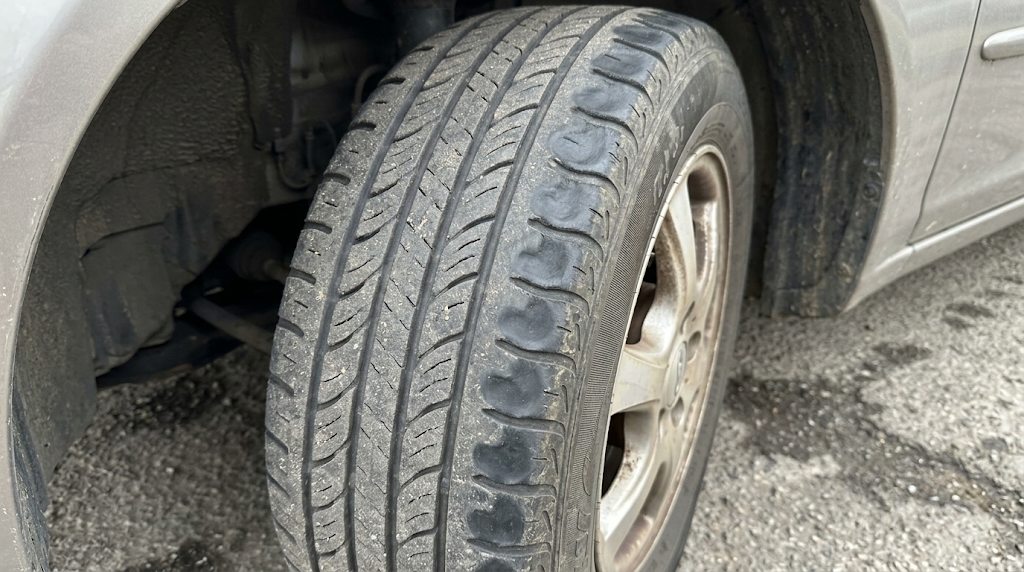
- Uneven tire wear. When the wheel is bouncing, the pressure on the road is not constant. Wave-like or scalloped sections can appear on the tread. Such wear can, however, also be caused by incorrect alignment or balance.
- Oil on the shock absorber body. A light oily film does not necessarily mean a failure, but pronounced oiling and running fluid indicate a seal problem.
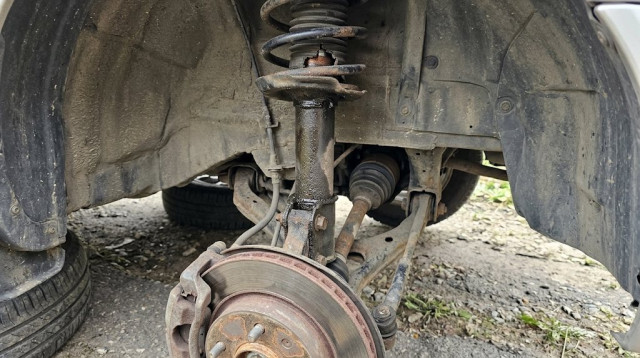
- Knocking and clunking. The noise does not always come from the shock absorber itself. Possible culprits include the top mount, bearing, tie rods, bushings or the bump stop.
.
When to replace shock absorbers?
There is no single mandatory interval for all cars. The life of shock absorbers depends on the design, the car's weight, road conditions, load and driving style.
Around 80,000 km it is reasonable to perform a detailed inspection, even if there is no obvious problem. Under normal use many shock absorbers retain acceptable performance between 80,000 and 160,000 km. This is an indicative range, not a guaranteed lifespan.
Driving on broken roads, frequent hits into potholes, overloading, towing a trailer and crossing bumps at high speed can significantly shorten service life. A shock absorber may need replacement well before the indicated mileage if it has leaked, bent or been damaged in a strong impact.
How to check shock absorbers?
The home test of pressing the fender can only show severe wear. If the body bounces repeatedly after releasing, there is reason for a service check, but quick settling does not guarantee that the shock absorber is completely sound.
A reliable check includes:
- inspection for leaks, corrosion and deformations;
- examination of dust boots and bump stops;
- checking tires for unusual wear;
- test drive to assess stability;
- inspection of springs, mounts, bearings and the other suspension parts.
It is good practice to have the suspension checked at least once a year, and also when changing tires, repairing brakes or adjusting alignment.
Why are shock absorbers replaced in pairs?
If only one shock absorber on an axle is new, the two wheels can react differently during braking, turning and passing over bumps. That is why shock absorbers are replaced in pairs – both front or both rear.
During the repair the top mounts, bearings, boots, bump stops and springs should be inspected. Replacing only the shock absorber when accompanying components are damaged may leave noises and instability unresolved. After work on front struts an alignment check is often also necessary.
The most important thing is not to wait for a certain mileage if there are already clear signs of worn shock absorbers. A leak, excessive bouncing and unstable behavior are reason for timely diagnosis, because it is not only about comfort but also about control of the vehicle.

How to get here

Open in Google Maps
Varna, Hr. Smirnenski Blvd., 29