


16 November 2026
ReadEGR valve – what does it do and what problems does its clogging cause
19 November 2026
Contents
The EGR valve rarely attracts attention while the car is running normally. When jerking, unstable idle, or loss of power begin, it quickly becomes the prime suspect. The problem is that the same symptoms can be caused by the mass airflow sensor, turbocharger, vacuum hose, injector, or a dirty intake manifold.
Therefore, a lit Check Engine light and a fault for insufficient EGR flow do not automatically mean the valve must be replaced. For the right solution, we first need to understand how the system works and what exactly happens when it becomes clogged.
What is the function of the EGR valve?
The abbreviation EGR comes from Exhaust Gas Recirculation. The system returns a controlled amount of exhaust gases to the intake manifold, where they mix with fresh air.
Because exhaust gases contain little oxygen, the mixture burns at a lower temperature. This limits the formation of nitrogen oxides — harmful emissions that form especially actively at high temperatures in the combustion chamber.
The engine computer controls the valve according to RPM, load, and temperature. The EGR is not constantly open. In many engines it operates mainly at partial load, while in other modes it closes or changes position. Modern systems may have electric actuation, a position sensor, and a cooler for the recirculated gases.
Why does the EGR get clogged?
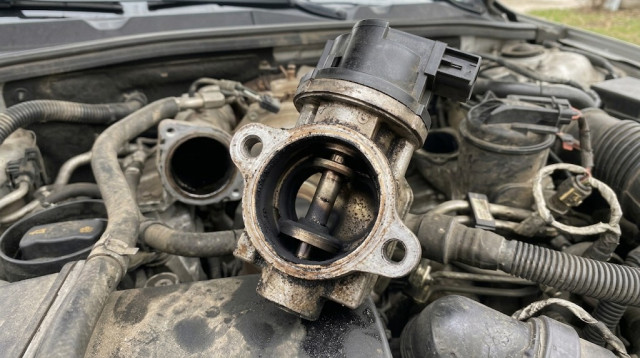
Gases containing soot pass through the valve. At the same time, a fine oily mist from the crankcase ventilation enters the intake system. The two residues form a dense, sticky layer that gradually narrows the passages and impedes the valve’s movement.
City driving over short distances and frequent cold engine operation can accelerate the buildup. Heavy contamination, however, sometimes indicates another problem:
- faulty crankcase ventilation;
- excessive oil in the intake system;
- worn or faulty turbocharger;
- inappropriate oil or too high oil level;
- improper injector operation;
- problem with the mass airflow sensor or engine management.
This is an important detail. If only the EGR valve is cleaned but the cause of the excessive deposits remains, the problem will likely recur.
What are the symptoms of a clogged EGR?
The car’s behavior depends on whether the valve is stuck open, closed, or moves only partially.
When the valve stays open
Exhaust gases enter the engine at a time when more fresh air and oxygen are needed. Possible signs are:
- uneven idle;
- jerking when starting off;
- delayed throttle response;
- reduced power;
- tendency to stall;
- black smoke in a diesel engine;
- increased fuel consumption;
- limp mode.
In a diesel, an overly open EGR can lead to an air shortage and incomplete combustion. However, black smoke alone is not proof — it can also be related to the injectors, the turbo, the air ducts, or the mass airflow sensor.
When the valve stays closed
If the EGR does not open, the engine may continue to run relatively normally, but nitrogen oxide emissions increase. There may also be higher combustion temperatures, rougher running, and knocking in some gasoline engines.
In both cases the Check Engine light may come on. Common codes include P0401 for insufficient flow and P0402 for excessive flow. They describe the result reported by the system but do not necessarily point to a defective part.
How is the EGR system checked?
Good diagnostics do not begin with removal and cleaning, but with reading fault codes and operating parameters. The service technician can compare the commanded and actual valve positions, monitor mass airflow readings, and activate the EGR via a diagnostic tool.
The following are also checked:
- the electrical connector and wiring;
- vacuum hoses in pneumatic systems;
- movement of the actuating mechanism;
- channels and pipes for accumulated deposits;
- the mass airflow sensor and temperature sensors;
- the intake system for leaks;
- the EGR cooler for coolant loss.
Sometimes the valve responds to an electrical test, but the passage around it is so dirty that the actual flow remains insufficient. In other cases the EGR is fine and the fault comes from a sensor, a vacuum issue, or a blocked passage.
Clean or replace?
Cleaning makes sense when the valve is mechanically and electrically sound, but its movement or passage is restricted by deposits. It should be carried out with a method appropriate to the specific design. Aggressive cleaners and submerging the electrical part can permanently damage the component.
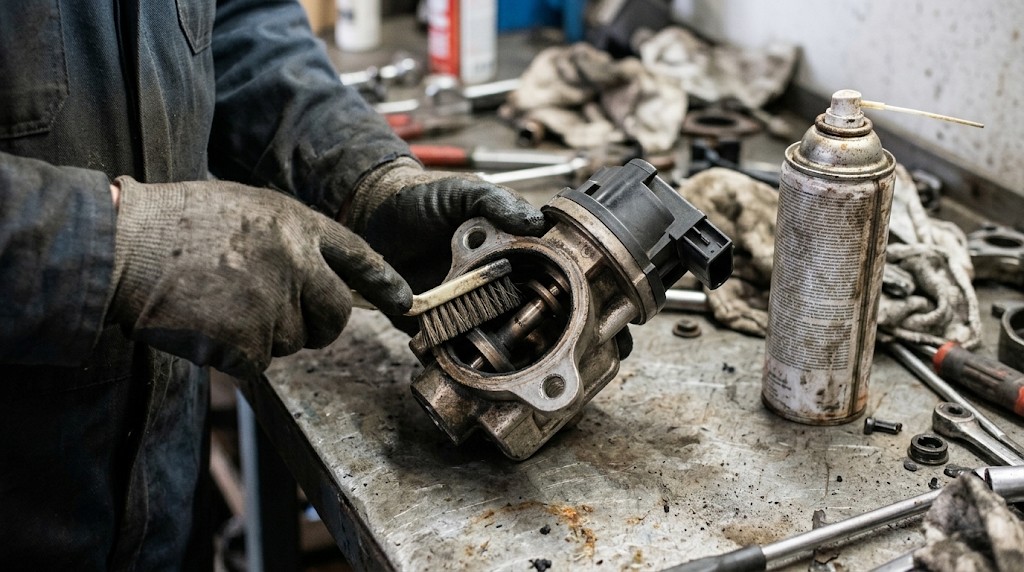
Replacement is more sensible in the case of a defective electric motor, a damaged position sensor, worn mechanics, a torn diaphragm, or thermal deformation. On some cars, adaptation with a diagnostic tool is required after installation.
Can the EGR be "cleaned out" by driving?
Prolonged driving with a well-warmed engine is beneficial for the overall condition of the car, but it cannot reliably free a valve that has already seized. Under high load, the EGR in many engines even closes. Therefore, highway driving is not a universal repair.
Blanking off or software disabling also does not solve the initial fault. It increases emissions and can create problems with engine management and the other exhaust gas control systems.
The most important conclusion is simple: the EGR valve should neither be blamed without diagnostics nor mechanically cleaned at every error. The exact cause can only be determined by combining electronic diagnostics, visual inspection, and checking related components.

How to get here

Open in Google Maps
Varna, Hr. Smirnenski Blvd., 29