


19 November 2026
ReadSymptoms of a damaged turbocharger and how to extend its life
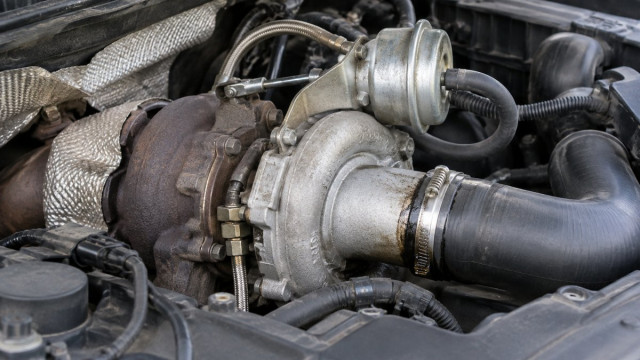
03 November 2026
Contents
- What is the role of the turbocharger?
- What are the most common symptoms of a faulty turbocharger?
- What most often damages the turbocharger?
- How to extend the life of the turbocharger?
- What to do if you suspect a turbo problem?
- Can a damaged turbo damage the engine?
- Repair, reconditioning or a new turbocharger?
- Small habits can save a big repair
The turbocharger is one of the components that has the greatest impact on the power, efficiency and behavior of the modern engine. Thanks to it, the engine can develop more power without necessarily significantly increasing its displacement. At the same time, the turbo operates at very high speeds and temperatures, which makes it sensitive to improper maintenance, unsuitable oil and problems in other vehicle systems.
The good news is that failure rarely occurs completely without warning.
In many cases the car begins to show certain signs before the turbocharger fails seriously. If you recognize them in time, you can avoid not only an expensive turbo replacement, but also subsequent engine damage.
What is the role of the turbocharger?
For an engine to run it needs air and fuel. The turbocharger uses the energy of the exhaust gases to supply more air to the engine. This allows more fuel to be burned and consequently more power to be generated.
At the core of the system are two turbine wheels connected by a shaft. One is driven by the exhaust gases, and the other compresses the air that enters the engine.
In theory the design looks relatively simple. In practice, however, the turbocharger shaft can rotate at extremely high speed and works under significant thermal load. That is why good lubrication and cooling are so important.
What are the most common symptoms of a faulty turbocharger?
Trouble with the turbo does not always start with a sudden loss of power. Sometimes the first signals are relatively small and can easily be overlooked.
Here are some of the most characteristic signs.
1. The car loses power
One of the first symptoms is often a noticeable change in acceleration.
The car may:
- accelerate more slowly than usual;
- lack sufficient power when overtaking;
- feel "heavy" when climbing;
- not reach its usual pull at higher revs.
The cause may be insufficient boost pressure from the turbocharger.
However, it is important to know that loss of power does not automatically mean a failed turbo. Similar behavior can be caused by a cracked turbo hose, a problem with the intercooler, the mass airflow sensor (MAF), the EGR system or the turbo control.
2. Unusual whistling sound
A turbocharger can normally make a slight whistle during acceleration. More concerning is a sudden change in the sound.
If the turbo begins to whistle significantly louder, to produce a siren-like sound, or if metallic scraping appears, the car should be inspected.
The cause may be:
- worn bearings;
- a problem with the turbine wheel;
- excessive shaft play;
- damage to the air ducts;
- air leaking under pressure.
Metallic noise in particular should not be ignored, as it may indicate mechanical damage.
3. Bluish smoke from the exhaust
Blue or bluish-gray smoke is often associated with burning engine oil.
With a turbo problem, oil can enter the intake or exhaust system. This is usually accompanied by a gradual drop in oil level.
Blue smoke, however, can also have other causes, including piston ring, valve or other engine component issues. Therefore diagnostics are needed before concluding that the turbo is to blame.
4. Black smoke under acceleration
Excessive black smoke usually indicates that the engine is receiving more fuel relative to the amount of air required for normal combustion.
If the turbocharger is not supplying enough air, black smoke can appear under load.
However, a similar symptom can also be caused by:
- a cracked or disconnected air duct;
- a problem with the intercooler;
- a clogged air filter;
- improper EGR operation;
- a problem with the MAF sensor;
- a fault in the fuel system.
Therefore the color of the smoke is a useful clue, but not a diagnosis on its own.
5. Increased engine oil consumption
If you start topping up oil significantly more often without seeing an obvious external leak, the cause should be determined as soon as possible.
With wear of certain turbocharger components, oil can pass to the intake or exhaust side.
Watch not only the warning light on the dashboard, but periodically check the oil level according to the manufacturer's recommendations.
6. Check Engine light comes on
Modern cars monitor a number of parameters related to turbocharger operation.
If the computer detects that the actual pressure differs significantly from the expected, it may log a fault and illuminate the Check Engine light.
The car may also go into so-called limp mode, in which power is intentionally limited to protect the engine.
Computer diagnostics are especially useful here, but the fault code should not be considered in isolation. It points to a problematic system, not necessarily a specific damaged part.
7. Oiling around the turbo and hoses
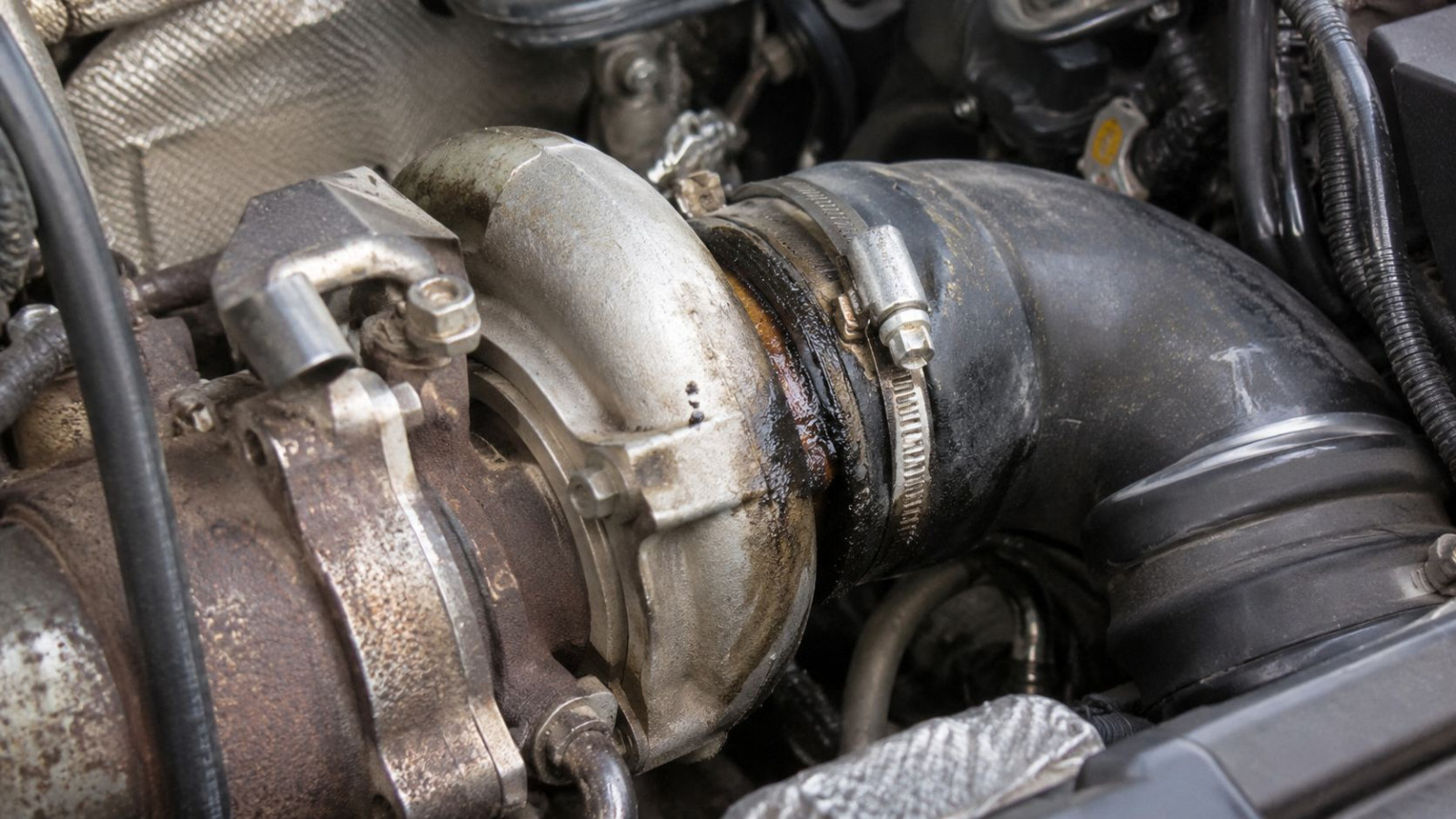
Small traces of oil in the intake system do not always mean a serious problem. However, if a significant amount of oil accumulates around the turbocharger, connections or intercooler, an inspection is necessary.
Particular attention is warranted when oiling is combined with:
- loss of power;
- bluish smoke;
- decreasing oil level;
- unusual turbo noise.
8. The car enters limp mode
With a problem in turbo pressure the electronic control may limit power.
The driver usually feels a sudden loss of pull, although the engine continues to run.
This can happen with both insufficient and excessive turbo pressure.
In variable geometry turbochargers one possible cause is soot buildup that prevents the mechanism from moving normally.
What most often damages the turbocharger?
Interestingly, in many cases the turbo itself is not the root cause of the problem.
Failure can be the result of another defect or of improper operation.
Insufficient lubrication
This is one of the most serious risks.
The turbocharger depends on a constant supply of quality engine oil. With insufficient lubrication the bearings and shaft can wear very quickly.
Causes can include:
- low oil level;
- a clogged oil feed line;
- a problem with oil pressure;
- wrong viscosity or specification;
- excessively long intervals between oil changes.
Contaminated or unsuitable oil
Old oil gradually loses some of its properties and can contain various contaminants.
When it comes to the turbocharger, the quality of lubrication is critical. Therefore using oil with the correct specification is much more important than choosing solely by price or brand popularity.
Ingress of foreign objects
The turbine wheels rotate at enormous speed. Even a relatively small object or particle can damage the blades.
This can happen due to a problem with the air filter, incorrect assembly or the presence of particles in the intake or exhaust system.
Problems with the DPF and EGR
Especially in diesel cars, problems with the DPF, EGR and turbocharger are often related.
If the exhaust system does not work properly, backpressure and temperature can change. Soot buildup can also impede the operation of a variable geometry turbo.
Therefore replacing the turbine without identifying the cause of the initial failure can sometimes lead to problems with the new turbo as well.
How to extend the life of the turbocharger?
Proper operation does not require complicated procedures. A few good habits can significantly reduce the load on the turbo.
Change the oil on time
If you must choose only one rule, this is probably the most important.
Use engine oil that meets the manufacturer's specification and do not neglect the change interval.
For a car mostly used on short urban trips, the engine often works under tougher conditions than the mileage suggests. In such cases a more conservative service interval may be a sensible decision.
Do not strain a cold engine
After starting, the oil needs to reach all components and gradually come up to the proper operating temperature.
It is not necessary for the car to idle for a long time. The better approach is usually to drive the first kilometers gently, without high revs and harsh acceleration.
Once the engine and oil warm up, the load can be gradually increased.
Do not switch off the engine immediately after heavy load
Imagine the following situation: you have been driving at high speed on the motorway for a long time, stop at a petrol station and immediately switch off the engine.
The turbocharger may still be very hot.
After prolonged high load it is good practice for the final minutes of the trip to be calmer. If this is not possible, a short period with low load before shutdown can help the temperature drop gradually.
However, in normal city driving it is not necessary for the engine to idle for a long time after every parking.
Replace the air filter
The air filter may seem like a relatively cheap and simple consumable, but it has an important task.
It protects the compressor side of the turbo from dust and particles. A heavily contaminated filter can also restrict airflow.
Therefore regular replacement is a small investment with potentially large effect.
Check turbo hoses and the intercooler
Sometimes the "faulty turbo" is actually a cracked hose.
If compressed air leaks between the turbocharger and the engine, the car can lose power and give the impression of a serious turbo failure.
Checking the hoses, clamps and intercooler should be part of the diagnostics.
Do not drive constantly at excessively low revs
Driving in the highest possible gear does not always mean gentler operation.
If the engine is at very low revs and the driver presses the gas pedal hard, the engine works under a heavy load. It is more appropriate to choose a gear in which the engine runs comfortably within its normal rev range.
What to do if you suspect a turbo problem?
The biggest mistake is to continue driving the car for a long time hoping that the noise or loss of power will go away.
If you notice a combination of unusual noise, excessive smoke, rapid oil loss and serious loss of power, the inspection should not be delayed.
During diagnostics it is good to check not only the turbocharger itself, but also:
- Turbo pressure.
- Oil supply and return.
- Air ducts and hoses.
- The intercooler.
- The vacuum system, if the car uses one.
- The turbocharger actuator.
- The EGR system.
- The DPF in diesel cars.
- MAP and MAF sensors.
- The condition of the intake and exhaust system.
This check is important also when a turbo replacement or reconditioning is planned.
If the root cause is not removed, the new turbo can fail again.
Can a damaged turbo damage the engine?
Yes, in some failures the risk is not limited to the turbocharger itself.
A serious mechanical defect can lead to oil or particles entering the intake system. Therefore in the case of a sudden severe loss of power, unusual metallic noise or very heavy smoking it is not reasonable to continue using the car without inspection.
Particular attention should be paid if the engine begins to rev on its own or a very large amount of smoke appears. This can be a dangerous situation and the vehicle should be stopped and inspected by a specialist.
Repair, reconditioning or a new turbocharger?
The right choice depends on the specific damage. Not every turbo with symptoms necessarily requires a full replacement. Sometimes the problem is in the actuator, the variable geometry mechanism, vacuum control or a peripheral component. In other cases the turbocharger can be professionally reconditioned. In case of severe mechanical damage a new unit may be necessary. Regardless of which option is chosen, the key question remains: Why did the old turbo fail? If that question remains unanswered, the repair is only half the solution.
Small habits can save a big repair
The turbocharger is not a consumable that must be replaced at a specific mileage. With proper maintenance it can run for a long time reliably.
The most important rules are actually relatively simple: use the correct oil, change it on time, do not strain a cold engine, keep the intake and exhaust system in good condition and do not ignore unusual noises, smoke or loss of power.
And when a problem appears, look for the cause, not just the damaged part. Proper diagnostics often makes the difference between a relatively small repair and an expensive failure of the turbocharger or the engine.
Frequently Asked Questions
How many kilometers does a turbocharger last?
There is no universal mileage after which the turbocharger must necessarily be replaced. Its lifespan depends on the design, the engine, the quality of maintenance, the oil, and the way it is used.
A well-maintained turbo can run for a long time without serious problems, while insufficient lubrication can damage even a relatively new component.
Is it normal for the turbo to whistle?
A slight whistling under load may be normal. If the sound suddenly becomes significantly louder or turns into a howl, a siren, or metallic scraping, a diagnostic check is recommended.
Does black smoke necessarily mean a damaged turbo?
No. Black smoke can be related to an insufficient amount of air, but the cause can be a cracked hose, the EGR, the air filter, the mass air flow sensor, or a problem in the fuel system.
Can you drive with a damaged turbocharger?
It depends on the nature of the fault, but prolonged driving with a seriously faulty turbo carries a risk of additional damage. If there is heavy smoke, metallic noises, rapid oil loss, or a sudden loss of power, the vehicle should be diagnosed as soon as possible.
Should the turbocharged engine always be left to idle before being shut down?
No. During normal, relaxed city driving there is usually no need for the engine to run at idle for an extended period. More attention is required after heavy or prolonged loading, when the turbocharger has been operating at very high temperatures.

How to get here

Open in Google Maps
Varna, Hr. Smirnenski Blvd., 29